
· LAANDED Property Group
Crescent Head: Why We Backed Australia's Last Great Coastal Town
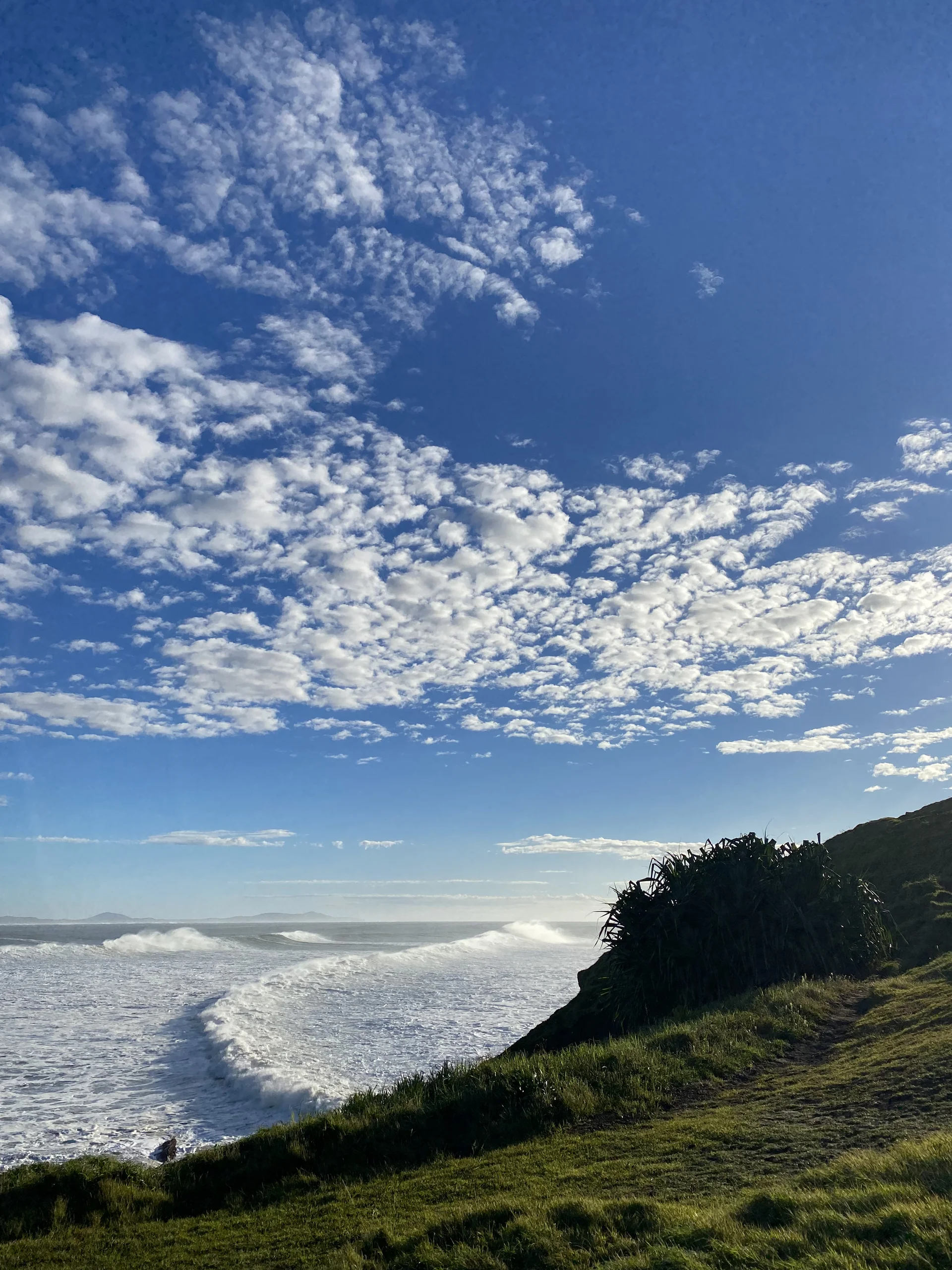
We were standing on Little Nobby headland at sunrise when Crescent Head stopped being a location assessment and became a conviction.
Waves crashing against the rocks directly below. The entire township laid out beneath us: every rooftop, every street, the creek bending through the village toward the sea. The golf course tracing the clifftop to the left. Big Nobby rising ahead. The coastline stretching north and south, completely uninterrupted, swallowed on every side by national park that will never be built on. The point break doing what it has always done, a hundred metres below, utterly indifferent to the property market.
Mesmerising. We stood there longer than made any professional sense. We did not want to leave.
That was the moment. But we had not come to Crescent Head for moments.
We came because the numbers pointed there
A coastal village on the NSW Mid North Coast, surrounded by national park on three sides, with no new residential land released in over 30 years. A median house price sitting at approximately $1 million, significantly below comparable coastal markets on the NSW coast. A demographic shift pouring people out of Sydney and into exactly this kind of place.
For a developer who assesses locations through infrastructure pipeline, planning certainty, supply constraints and capital viability, Crescent Head looked compelling on paper before we ever set foot there.
Why the numbers matter as much as the feeling
Crescent Head is not undervalued by accident. It is undervalued by timing. And timing, in property, is the only variable that separates the same asset at two very different prices.
Byron Bay. Lennox Head. Noosa. Avalon. Freshwater. Every one of these markets shares Crescent Head's fundamental attributes: world-class surf, village character, natural beauty, hard supply constraints from surrounding protected land. Every one has been discovered, repriced and celebrated in the travel press. Every one now trades at a median between $1.65 million and $4 million.
Crescent Head's median house price sits at approximately $1 million.
That gap, 60 to 75 percent below comparable coastal markets, reflects one thing: Crescent Head has not yet been repriced to reflect what it is. The surf is better than most. The national park boundary is more absolute. The village character is more intact. The only meaningful difference between Crescent Head today and Byron Bay in 2005 or Noosa in 2002 is that those markets have already moved. This one has not.
Then we went there. And the locals took us beyond the version most people see.
What the data does not tell you
You arrive and the pace changes immediately. Not in the way that every coastal town claims to slow you down, but genuinely, physically. The road narrows. The sky opens. The point break to the left has been producing rides of up to 400 metres since surfers first found it in the 1950s, and the people in the water look like they have nowhere else to be. Because they do not.
The village is small enough that the main street takes five minutes to walk end to end. Mornings begin at the surf club: coffee and breakfast on the lawn of grass while watching the surfers work the point below, one of the more quietly perfect ways to start a day anywhere in Australia. Green Room is an exceptional organic café for those who want something healthier; Black Fish does phenomenal coffee. The Med, a Crescent Head institution with its Italian restaurant that has quickly become a favourite for evening dining. And Sea Sea Hotel, a 25-room boutique property opened in November 2024 by George Gorrow, co-founder of Ksubi and creator of The Slow in Bali, with chef Daniel Medcalf formerly of Icebergs Dining Room, a surf gallery, a hi-fi lounge, and a cultural identity built from the village's own history. Design Hotels founder Claus Sendlinger has endorsed it as a property with international potential. Grazia, Time Out, Qantas Travel Insider and Boss Hunting have all taken notice.
The Crescent Head Country Club is the beating heart of the village's social life. Lawn bowls on the all-weather greens, tennis courts, a newly renovated mini putt putt course, and evenings that come alive with live bands and people dancing, the whole village finding its way there as the sun goes down. It is the kind of night that reminds you what community actually looks like. And when the mood calls for something simpler, the Crescent Head Tavern delivers exactly that: cold drinks on the deck, familiar faces, and the easy conversation that comes from a place where people genuinely know each other.
None of this was what surprised us most.
At low tide, a secret rockpool reveals itself at the base of the Back Beach cliffs: turquoise water, sandy bottom, completely invisible from the shore. Locals call it simply The Crescent. There is no sign, no path on any map. You have to know it is there. We found it on our second day, sat in it watching the ocean move beyond the rocks, entirely alone, in what felt like a private corner of the world. It is the kind of place that makes a person reconsider everything about where they are living and why.
Around Delicate Nobby and Racecourse headland, natural rock pools form with the outgoing tide, labyrinths of colour filled with starfish and sea anemone, quiet enough to hear the water move through the channels. The Big Hill loop walk through Limeburners Creek National Park rises through coastal heathland to panoramic views over wave-formed dunes and open sea. The Macleay River creek inlet runs through the edge of the village: flathead at high tide, children in the shallows, the stillness of a waterway that has not been built over.
Point Plomer: Crescent Head's Wategos
Then the locals told us to drive Point Plomer Road.
A short drive south, the road follows the national park boundary through coastal bush past hidden surf breaks that most of Australia has never heard of, waves tucked behind scrub, accessible only if you know where to pull over, known mainly to people who have been coming here for decades and prefer to keep it that way.
Halfway down sits Waves Campground, a place that transports you straight back to the 1960s. A community of surfers and campers who share waves, cook over fires and stay longer than they planned. There is nothing performative about it. It is what surf culture looked like before it became an aesthetic.
Further along sits Rancho Relaxo: 137 hectares of retreat grounds moments from Racecourse Beach, with Balinese-style villas, a private lagoon and accommodation set against open country and forested grounds. A hidden gem that draws surf lovers on retreat from around the world. The kind of place you only find if you know to look.
Point Plomer is Crescent Head's Wategos, the stretch just beyond the town that most visitors never reach, where properties are tucked into coastal bush beside beaches that belong almost entirely to the people lucky enough to live near them. Wategos became Byron Bay's most coveted address not because it was the most central, but because it was the most private, the most beautiful, and the hardest to replicate. Point Plomer carries the same logic, surrounded by national park, fronting world-class surf and pristine beach, accessible only to those who know to look. The properties here are rare. The setting is extraordinary. As Crescent Head's profile rises, Point Plomer will be understood in the same terms that Wategos is understood now, as the address within the address.
The land beneath it all
The Dunghutti people, traditional custodians of the Macleay Valley, have called this coastline home for at least 4,000 years. A stone fish trap from that era remains in the Crescent Moon waterway. Shell middens line the beaches at Barries Beach and Point Plomer. Big Hill, rising above the national park, holds deep spiritual significance passed through generations in oral history.
We left Crescent Head with the numbers confirmed, and something else entirely: the conviction that we had found a place quietly protecting its own character while the rest of the coast got discovered, developed and priced out of reach.
The scarcity is geographic and permanent
Crescent Head sits on a peninsula flanked by protected land on virtually every side. Goolawah National Park to the south. Limeburners Creek National Park, 9,123 hectares, stretching toward Port Macquarie. Hat Head National Park rising to the north across 7,400 hectares of coastline. National parks do not get rezoned. The rural land on the remaining boundaries carries no pathway to residential development.
Once the current land release absorbs, Crescent Head's housing supply is permanently fixed. Every future transaction occurs within a static pool. Price growth can only be driven by demand against an unchanging stock.
Noosa in 2018 had a median house price of approximately $695,000. By 2025 it had reached $2.5 million. The drivers were identical to what exists at Crescent Head today: limited land surrounded by parkland, lifestyle migration, fixed supply, and a growing cultural recognition that the place is genuinely special. Byron Bay followed the same arc. The transformation pattern runs the same way every time: discovery, early adoption, acceleration, maturation, permanent repricing. Crescent Head is at the inflection point.
The Crescent Estate, developed by our partners at Arissa Group, is the first residential land release in Crescent Head in over 30 years, and the last. The estate comprises 117 generously sized lots across two releases. The first, Parkside, has sold out. The second, The Aspect, is now selling from $680,000, with lots ranging from 650 to 733 square metres, positioned 900 metres from the beach. More than 30 blocks sold within three weeks of the Parkside launch. You can buy land and build a house at The Crescent for approximately $1.2 million. In the context of where comparable coastal markets are trading, that figure speaks for itself.
The migration tailwind is structural
The demand flowing toward Crescent Head is not a trend. It is a permanent structural shift in how Australians live and work.
Greater Sydney recorded 41,100 net departures to regional areas in 2023-24, accounting for 53 percent of all net capital city outflows nationally. The Commonwealth Bank Regional Movers Index, drawing on data from 14.3 million customers, shows capital-to-regional migration in Q3 2025 remains 40 percent above pre-pandemic levels. The Regional Australia Institute describes the trend as showing no signs of abating.
Remote work is the enabler, and it is permanent. More than a third of Australians now work from home regularly. Among knowledge workers, hybrid and remote arrangements are the default. The freedom to live where you choose rather than where your office requires has redrawn Australia's internal migration map, and the Mid North Coast is one of its clearest beneficiaries.
Port Macquarie-Hastings LGA, 45 minutes south of Crescent Head, recorded an 11.9 percent annual increase in new residents, ninth in Australia for internal migration. Kempsey Shire is projected to grow from 30,688 residents to 35,310 by 2036. The Mid North Coast records an inbound-to-outbound migration ratio of 1.44. For every 100 people leaving, 144 are arriving.
The infrastructure is already here
Crescent Head is 45 minutes from Port Macquarie, a regional city of 86,000 people growing toward 104,000 by 2036. A $265 million hospital expansion is underway. An airport whose terminal upgrade has doubled capacity offers daily flights to Sydney. Charles Sturt University's coastal campus is targeting 5,000 students by 2030, driving consistent housing demand across the region.
The Pacific Highway upgrades, including the $370 million Kempsey Bypass, have positioned Crescent Head within four hours of Sydney, Newcastle, the Gold Coast and Brisbane. NBN fibre runs throughout the village, making Crescent Head a genuine base for people who no longer need to choose between career and coastline.
In October 2025, Kempsey Shire Council adopted the Crescent Head Foreshore Concept Design, delivering expanded green space, nature-based playgrounds, improved beach and creek access, a dedicated markets space, a surf-check zone, and stronger connections through the village centre. The community's future is being actively invested in.
One more thing worth mentioning. Crescent Head Country Club is home to Australia's only accredited six-hole golf course, perched along the clifftop with sweeping views across the Pacific, where dolphins appear in the water below and whales pass during migration season. It is open to the public year round. Social golfer or serious, you will not forget this one.
Getting there is easier than most people realise. Port Macquarie Airport is 45 minutes south, with direct flights from Sydney making it a genuine fly-in destination for those who want to arrive without the drive. For those who do drive from Sydney, the journey itself is worth doing properly. Bulahdelah is the first stop, a picturesque little town on the Pacific Highway that deserves more than a passing glance. Then Nabiac, where The Artisan Farmer sits in the heart of town, a paddock-to-plate café, deli and bakery with their own Wagyu beef, garlic, ginger and honey grown on the property alongside produce from across the local community. It is the kind of food stop that food lovers talk about for the rest of the trip. By the time you arrive at Crescent Head, the drive will have felt like the beginning of something rather than the means to an end.
Fall in love with life again
That phrase is The Crescent Estate's own. We did not write it. But when we read it after the sunrise on Little Nobby, the rockpool at Back Beach, the drive down Point Plomer Road, we understood exactly what it means.
The best property decisions in lifestyle real estate begin with a feeling. A place that makes you reconsider the trade-offs you have been making. The rigour comes after. The data confirms what the instinct already knew.
Crescent Head confirmed both for us.
The scarcity is real and permanent. The cultural momentum has arrived. The migration tailwind is structural. The comparable markets that preceded this one are trading at two to four times the current price. And the feeling, the one that finds you on Little Nobby at sunrise with the whole coastline stretching out in every direction, is the kind that does not leave you.
We backed Crescent Head because the numbers told us to. We believe in it because we went there.
Fall in love with life again. Some of the best decisions begin exactly that way.
LAANDED Property Group invests in and develops residential and lifestyle assets across NSW's growth and lifestyle corridors. This article represents our perspective and does not constitute financial advice. For further information visit www.laanded.com.au or enquire directly about The Crescent Estate at thecrescentestate.com.au.
About LAANDED Property Group
LAANDED is a privately led property development and investment company active across residential, mixed-use, and lifestyle assets in NSW. Guided by legacy. Delivering long-term value.
All plans, images, artist's impressions, dimensions and descriptions are indicative only and subject to change without notice. Areas are approximate and subject to final survey and authority approval. Purchasers should rely on the contract of sale and final approved plans.